Order bucket hats for a summer camp, an outdoor festival crew, or a school field program and sun protection stops being a marketing word and becomes a real specification. Parents ask about it, camp directors require it, and in some settings a hat that does not actually block UV is a liability. The trouble is that the label language, UPF this and UV that, is genuinely confusing, and a lot of hats marketed as sun protective carry no tested rating at all. This is what the numbers mean, what stands behind them, and how to order a bucket hat that does the job rather than just looking like it does.
UPF is not SPF, and the difference matters
UPF stands for Ultraviolet Protection Factor, and it measures how much UV radiation a fabric lets reach your skin. It is often confused with SPF, the number on sunscreen, but they are not the same thing. SPF is tested on human skin and rates protection against UVB only, and it degrades as you sweat or swim. UPF is tested on the fabric itself in a laboratory, accounts for both UVA and UVB, and does not wash off during the day. A UPF number tells you, in effect, what fraction of the sun’s UV the material stops before it ever touches the wearer, which is exactly what you want to know about the brim and crown sitting over someone’s face and neck for hours.
Reading the number: what each rating actually blocks
The UPF scale is built from a simple definition. A rating means the fabric transmits one part of UV out of that number, so UPF 50 lets through one-fiftieth of the UV, or two percent, and blocks the other 98. Work through the common ratings and a pattern appears: UPF 15 blocks about 93.3 percent, UPF 30 about 96.7 percent, and UPF 50 about 98 percent, with UPF 50+ meaning more than 98 percent. Those percentages look close together, and that is where buyers get misled.
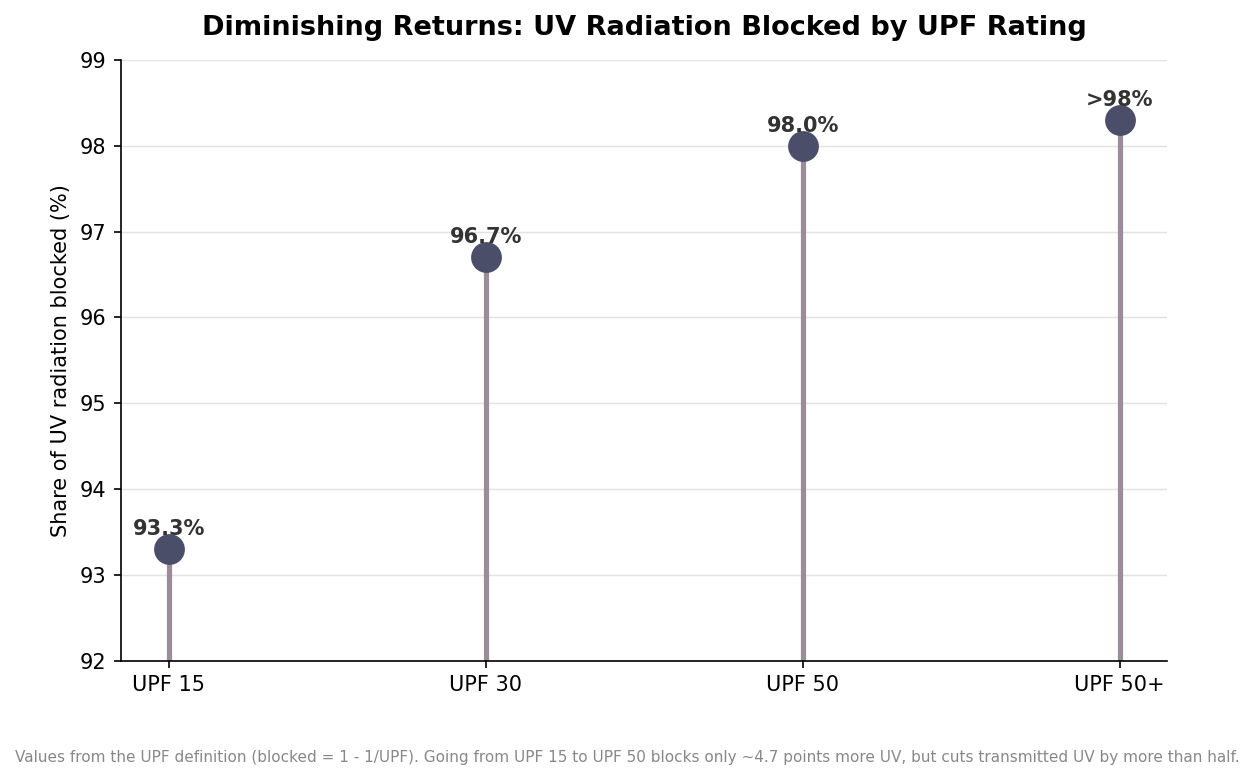
The honest way to read that chart is through what gets through, not what gets blocked. UPF 15 transmits 6.7 percent of UV; UPF 50 transmits 2 percent. So moving from UPF 15 to UPF 50 only raises the blocked figure by about five points, but it cuts the UV actually reaching the skin by more than two-thirds. For a child at camp under the sun all afternoon, that is a meaningful difference even though the headline percentages barely seem to move. When a rating is required, UPF 50+ is the standard worth specifying rather than settling for a merely adequate number.
The standards behind the label
A UPF claim only means something if it was tested to a recognized method, and there are three names worth knowing. In the United States, the test method is AATCC TM183, which measures UV transmittance on new, unstretched, dry fabric. The results are then classified and labeled under ASTM D6603, which sets the rules for what can legally be called sun protective and sorts fabrics into three grades. Australia and New Zealand, which take sun safety especially seriously, use their own calculation standard, AS/NZS 4399. The classification most US buyers will see comes from ASTM D6603 and looks like this.
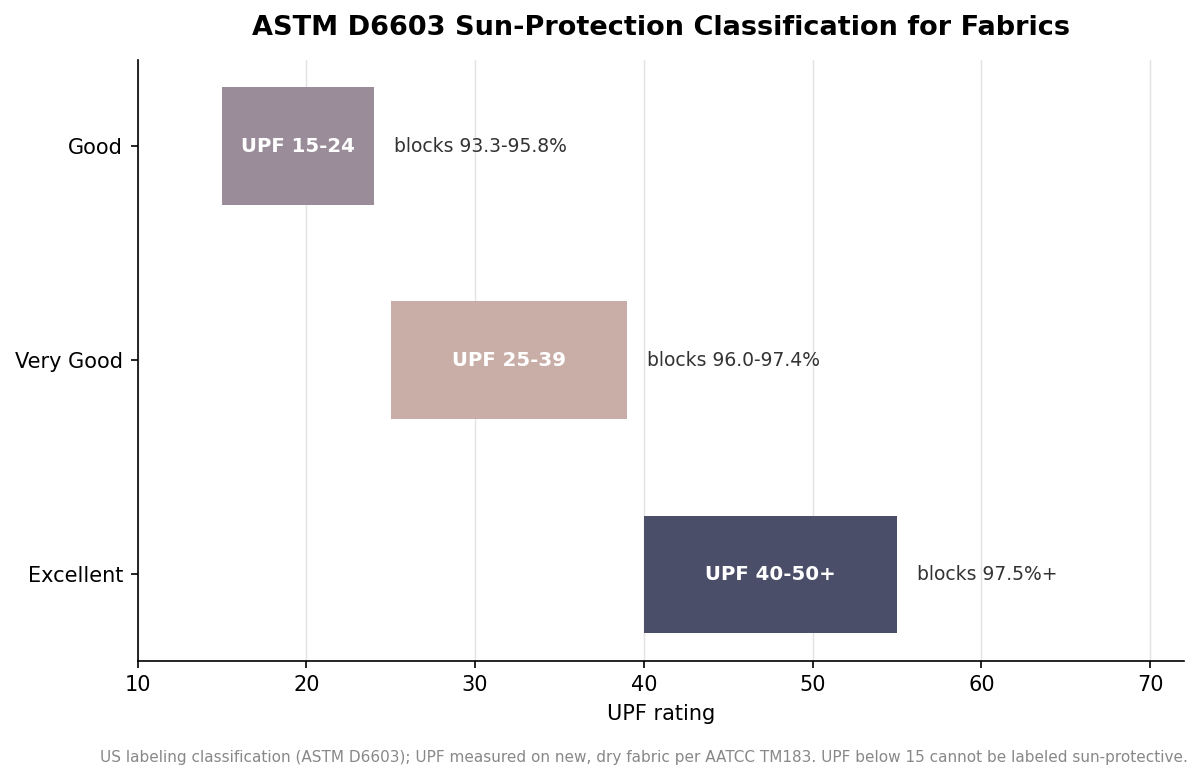
Two practical points follow from how the testing works. First, anything below UPF 15 cannot be labeled sun protective at all, so a hat with no rating is not automatically UPF 14, it is simply untested. Second, because the test is done on dry, new fabric, real-world protection can be lower: a hat that is soaked with sweat or pool water can drop one or more categories, and heavy wear over a season can reduce it too. If you need a guaranteed level, ask the supplier for the tested UPF rating and the standard it was tested to, in writing, rather than accepting sun protective as a loose adjective.
How fabric choice decides the rating
Here is the part that surprises people: color matters far less than weave. Dark, saturated dyes do absorb somewhat more UV than pale ones, but the dominant factor is how tightly the fabric is woven and what fiber it is made from. Tightly woven synthetic fibers like polyester and nylon hold their UPF well and keep it through washing, while looser natural fibers let more UV slip between the yarns. That is why a standard 100 percent cotton bucket hat, such as a light-to-mid-weight cotton blank in the mold of the widely used AS Color 1117, protects mainly through the tightness of its weave and its crown coverage, and will not carry a high tested UPF unless the specific fabric has been tested and rated. Cotton can still shade a face perfectly well; it just should not be sold as certified UV protection without the test to back it.
When protection is the priority, the specification writes itself: choose a tightly woven or performance fabric, favor a fuller crown and a wider, downturned brim that shades the ears and neck, and lean toward deeper colors where the design allows. When the hat is mostly a branded accessory for a giveaway or a casual event, a classic cotton bucket in one of a dozen colorways is a fine, affordable choice, and you simply describe it accurately as a cotton hat rather than a UV-rated one. Where the figures here are given as ranges, treat them as the framework rather than a promise about any one hat. The goal is to match the claim to the cloth, so the bucket hat you hand out actually protects the people wearing it and your program never has to walk back a promise it could not keep.