Before you settle a color, a logo, or a quantity, a custom bucket hat comes down to one earlier decision: what it is made of. Fabric sets almost everything you notice when the hat arrives, from how it breathes on a hot day to whether it sheds a drizzle, how much the brim holds its shape, and, just as important, which decoration method will actually look sharp on it. Pick the fabric to match the job first, and the rest of the order gets easier. This is a working guide to the materials you will actually be choosing between.
Cotton and cotton twill: the sensible default
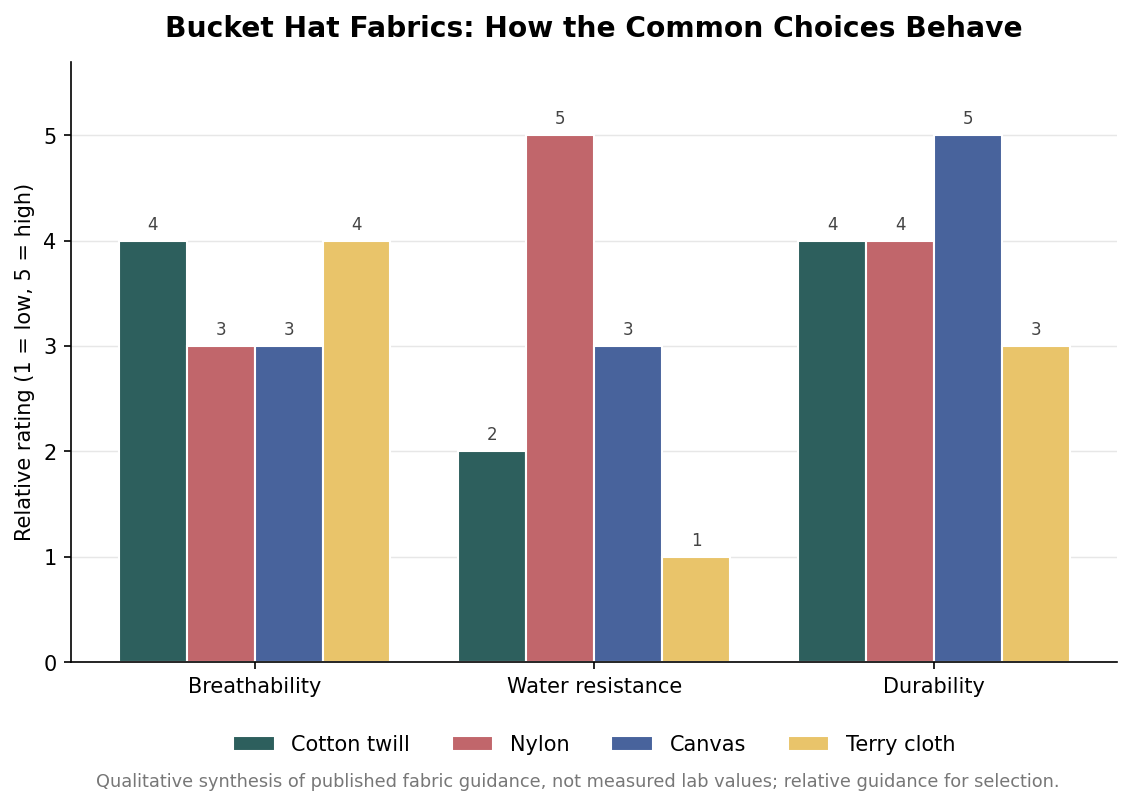
Cotton is the starting point for a reason. It breathes well, feels comfortable in warm weather, and takes dye and print, in one supplier’s phrase, like a fish to water. Cotton twill is the version most custom programs reach for because its surface is stable and textured enough to hold embroidery detail cleanly, which makes it the safe pick when a logo has to look crisp. A widely used cotton blank such as the AS Colour 1117 shows the familiar pattern: a light-to-mid-weight 100% cotton body, a reinforced brim held down with topstitching, side eyelets for a little airflow, and a one-size fit offered across a broad colorway range from army and black to bone, butter, and ecru. That combination of a stable surface, honest breathability, and wide color choice is why plain cotton and cotton twill cover the majority of everyday merch, giveaways, and streetwear basics.
Nylon and synthetics for the outdoors
When the hat will be worn fishing, hiking, or traveling rather than standing around at an event, synthetics earn their place. Nylon is lightweight, quick-drying, and water-resistant, packs flat for travel, and holds color without fading in the sun, which is exactly what an outdoor utility hat needs. Polyester adds durability and strong color retention along similar lines. The tradeoff is on decoration: a thin nylon shell can make heavy embroidery feel dense and stiff, so these fabrics usually look better with woven patches and labels than with a big stitched design. If your use case is sun, water, and packability, a synthetic shell is the right body, and you simply plan the branding around a patch rather than a dense embroidery.
Canvas, corduroy, and terry: structure, season, and feel
The specialty fabrics are where a hat gets a point of view. Canvas is robust and holds a firmer, more structured brim, which suits a rugged or workwear look and stands up to hard use. Corduroy, often an 8-wale cotton cord, reads vintage and skate-inspired and photographs beautifully in fall and winter drops; because its ribbed surface fights fine detail, it looks best with a minimalist logo, a woven label, or a patch rather than intricate stitching. Terry cloth, the towel-like material, is soft and playful and made for beach, poolside, and resort collections, though its whole nature is to soak up water rather than repel it, so it belongs nowhere near a rainy-day brief. Matching one of these to the season and the mood of the collection is what separates a considered hat from a generic one.
Match the decoration to the fabric, not the other way around
A recurring mistake is choosing the decoration first and forcing it onto the wrong fabric. The reliable pairings are straightforward. Embroidery looks best on stable, textured surfaces like cotton twill and canvas, where the stitches sit cleanly and hold their shape. Woven patches and labels are the better call on nylon and corduroy, where dense stitching would pucker or disappear into the texture. Prints, including all-over patterns, sit best on smooth cotton and polyester that accept ink evenly, which is why a camo or graphic bucket is almost always a printed cotton or poly rather than a corduroy. Decide the fabric for the use case, then choose the decoration that the fabric wears well, and the finished hat looks intentional instead of fought-with.
What the fabric does to your budget
Fabric is also the biggest single lever on per-hat cost before you add decoration and quantity. Plain cotton twill is the value pick, and every step toward a specialty fabric such as nylon, terry, canvas or corduroy, or toward a heavier weight, tends to nudge the unit cost up. The final per-hat cost also moves with order size, finish, and how much stitching or printing you add, so the most accurate way to budget is to request a quote for your exact spec. If a budget is tight, the smart move is to spend on getting the fabric right for the use case and keep the decoration clean, rather than the reverse.
Putting the order together
The clean sequence is fabric, then decoration, then color and quantity. Start from where and how the hat will be worn: cotton or cotton twill for everyday merch and events, nylon or polyester for sun and water, canvas for structure and hard wear, corduroy for a vintage seasonal drop, terry for the beach. Confirm the decoration your chosen fabric wears well, keeping embroidery on the stable surfaces and patches on the textured or technical ones. Only then lock the colorway and count. Do it in that order and the fabric stops being an afterthought and becomes the decision that makes everything downstream, the fit, the look, and the branding, fall into place.