Category: Uncategorized

  • How to Choose a Custom Bucket Hat by Use Case: Festivals, Fishing, Golf, and Brand Merch

    How to Choose a Custom Bucket Hat by Use Case: Festivals, Fishing, Golf, and Brand Merch

    The phrase “bucket hat” covers a surprising range of hats, and the version that makes a festival crowd look sharp is not the one that keeps an angler dry on an open lake. When you order custom bucket hats in bulk, the decoration and the logo usually get all the attention, but the choices that decide whether recipients actually wear the hat are structural: brim width, fabric, crown shape, and ventilation. This guide works backward from four common use cases to the hat features that fit them, so you specify a blank that suits the job before you ever pick a print method.

    Start with the brim, because it sets the whole silhouette

    Brim width is the fastest way to sort styles, and it correlates directly with sun coverage and with the look. Standard bucket brims run roughly 6.5 to 7.5 centimeters, about 2.6 to 3 inches, and that is the balanced, everyday proportion most people picture. Short brims of about 5.5 to 6.5 centimeters give the low-profile, Gilligan-style look that reads retro and streetwear. Wide brims stretch to 7.5 to 9 centimeters, near 3 to 3.5 inches, and buy meaningfully more shade, which is why they dominate women’s summer styles and sun-focused ranges. A boonie, often lumped in with bucket hats, actually carries a fixed brim of around 2 and 3 eighths inches, close to 6 centimeters, but stiffens and angles it for coverage rather than relying on width alone.
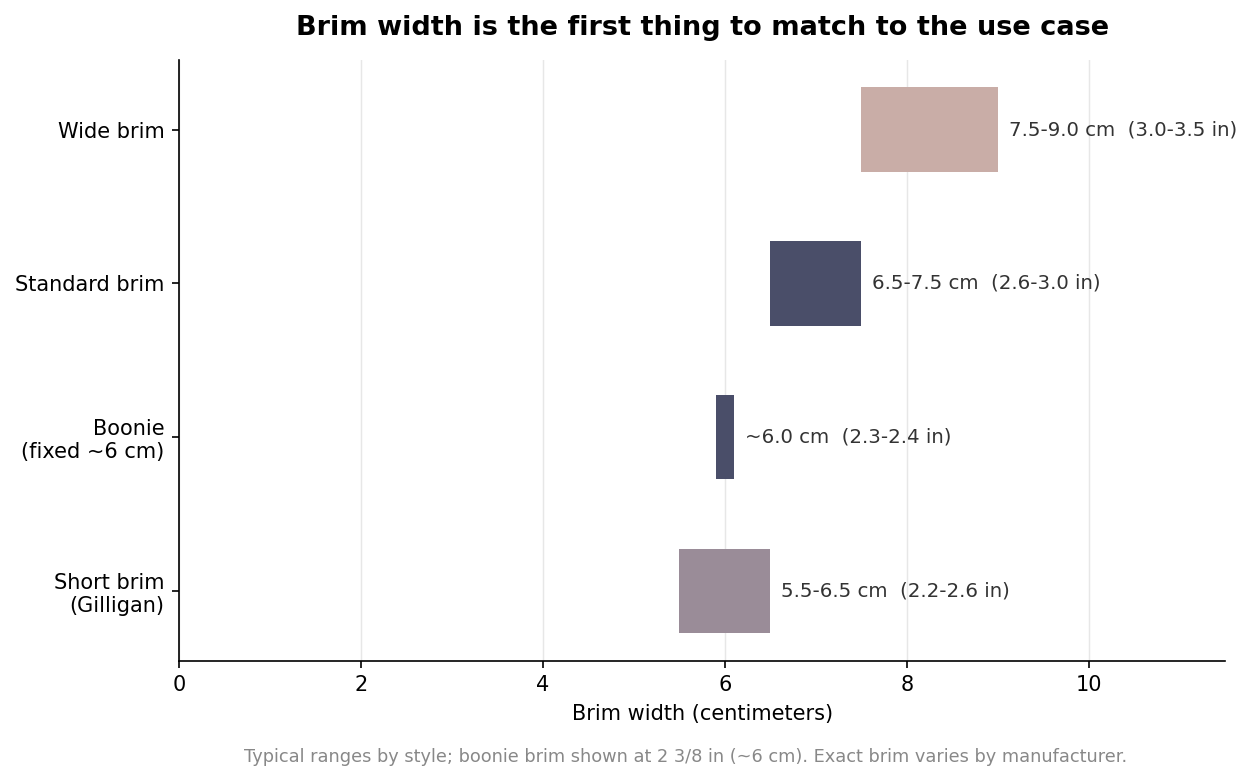
    Horizontal range chart of bucket hat brim widths in centimeters for short, boonie, standard, and wide styles
    Brim width by style, in centimeters and inches; wider brims trade packability for sun coverage.

    Festivals and everyday brand merch: comfort and print quality first

    For giveaways, team merch, and festival drops, the hat is a canvas for your brand and a comfort item, so a soft, lightweight, 100 percent cotton bucket in a standard brim is the workhorse. Cotton twill takes embroidery cleanly and holds bold color, and a round-top, unstructured crown packs down for tote bags and gift boxes. A representative blank in this lane is the AS Color 1117, a light-to-mid weight 100 percent cotton bucket with a reinforced, stitched brim and side eyelets, sold in one size with a deep bench of colorways including army, black, bone, butter, and ecru. Its camo sibling, the 1117C, runs an all-over lightweight cotton print for a bolder base. Neutral tones like bone and ecru make embroidered logos pop, while the reinforced brim keeps the shape after the hat gets stuffed in a bag and pulled back out a dozen times.

    For this use case, packability matters more than weatherproofing. A hat that folds flat travels well as a promotional item and survives the abuse of a music weekend, and cotton’s breathability keeps it comfortable in a crowd. Save the technical fabrics for the outdoor lanes below.

    Fit is the other quiet decision. Most promotional buckets are sold as one size, which relies on the depth of the crown to sit across a wide range of heads, and that is usually fine for a giveaway where nobody is fussy about a precise fit. If you are outfitting a defined group, or want a cleaner look on smaller heads, choose a blank offered in graded sizes or one with an internal toggle or drawcord that snugs the fit. Confirm the head circumference the one-size version is cut for, because a hat that perches too high reads as cheap no matter how good the embroidery is.

    Sun and water: fishing, hiking, and the beach

    When the hat has a real job outdoors, the priorities flip toward coverage, quick drying, and ventilation. Here a wide-brim bucket or a proper boonie earns its place. Boonies are typically built from heavier, tougher cloth such as a 6.4 ounce 65 percent polyester, 35 percent cotton ripstop, with metal vent eyelets or mesh panels to move air during hot, active use. Fishing-style buckets add reinforced stitching, a windproof drawcord to keep the hat on in a breeze, and side webbing or D-rings for gear. If the hat will get wet, a nylon-polyester blend with a durable water repellent finish sheds spray and dries fast, holding a sharper brim line than cotton, which soaks and sags. This is also the lane where UPF ratings matter most, and tighter weaves and synthetics generally block more UV than an open-weave cotton.
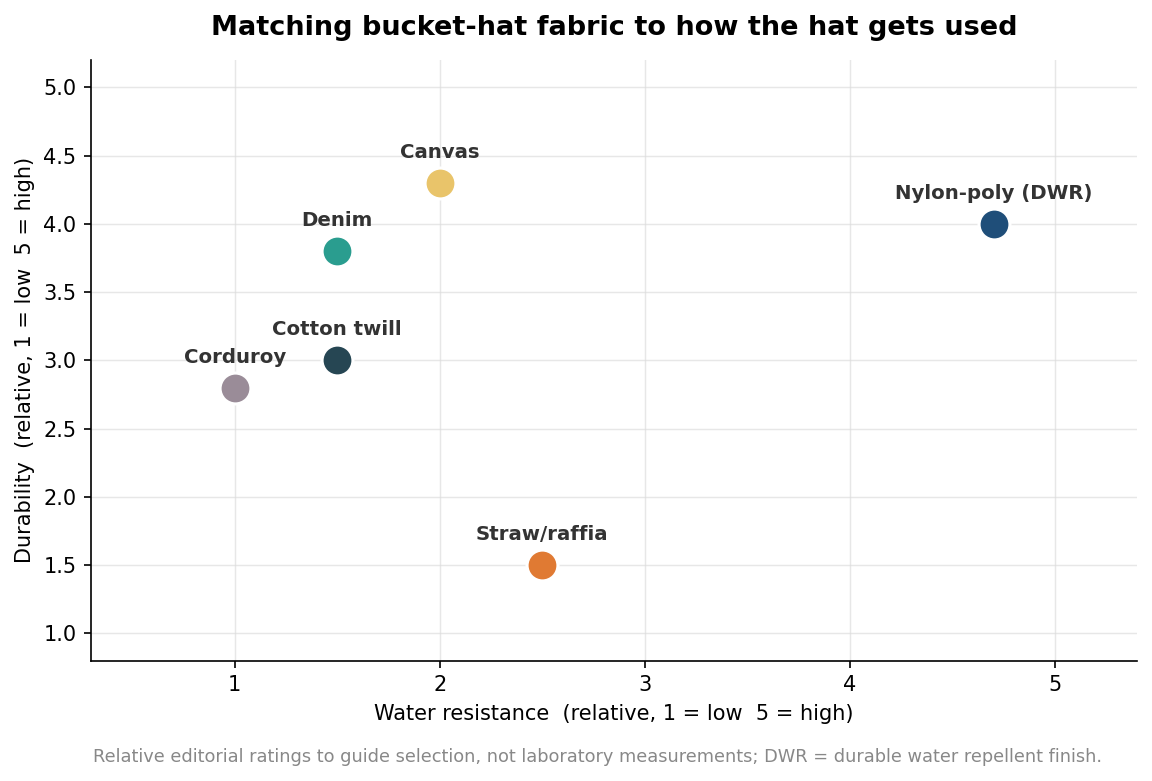
    Scatter plot rating bucket hat fabrics by relative water resistance and durability
    A relative guide to fabric selection by water resistance and durability; DWR nylon-poly leads for wet, active use.

    Golf and active wear: a middle ground

    Golf and general active use sit between the merch and expedition extremes. Players want sun coverage without a floppy brim that catches the wind on a backswing, so a standard-to-slightly-wide brim with a bit of structure works well, and moisture management beats pure cotton over four hours in the sun. A poly or poly-cotton blend with a DWR finish handles sweat and light rain and keeps its shape, while a sweatband improves comfort on a hot round. Denim and canvas, both durable and heavier, suit workwear-styled and streetwear ranges but run warm, so they fit cooler seasons better than midsummer play. Corduroy and wool or tweed push further into fall and winter and support a more premium, vintage-leaning collection.

    Turning use case into a spec sheet

    Once you know the scenario, the order details fall out of it. Pin down brim width in centimeters or inches rather than a vague “standard,” name the fabric and, where the supplier can provide it, the weight, and state whether you need an unstructured, packable crown or a stiffer one that holds a brim. Decide on ventilation, eyelets or mesh, and any hardware like a drawcord before you lock the blank, because those are construction features you cannot add after the fact. Match the decoration to the fabric last: embroidery suits cotton and canvas, while all-over sublimation needs a polyester base. Get those structural calls right and the logo lands on a hat people actually keep wearing, which is the only version of custom headwear that pays for itself. The fabric ratings above are a relative guide to speed selection, not lab measurements, so confirm specifics like exact weight and UPF against a supplier’s spec sheet for the blank you choose.
  • Embroidery, Sublimation, or Patch: Choosing a Decoration Method for Custom Bucket Hats

    Embroidery, Sublimation, or Patch: Choosing a Decoration Method for Custom Bucket Hats

    The blank you pick decides how a custom bucket hat feels in the hand. The decoration method decides how it reads across a room, how long the branding survives, and what the order actually costs. Most buyers agonize over cotton versus poly and then choose a decoration method by habit, which is how a clean logo ends up as a fuzzy, oversized patch on the front panel. This guide walks the four methods that dominate bucket hat production, what each one is genuinely good at, and how to match the method to your order size and your artwork.

    Embroidery: the default for logos, with real limits

    Embroidery is the workhorse for bucket hats because stitched thread adds texture, resists cracking and fading, and reads as higher quality than a flat print on cotton or twill. It is the right call for a clean wordmark or a simple one-to-four-color logo. The limits are physical: thread comes in a fixed palette, usually on the order of ten to fifteen usable colors on a standard machine, so gradients and photographic art do not translate. Text needs to stay legible at thread scale, which in practice means keeping letters at least a quarter-inch tall and avoiding detail finer than about an eighth of an inch.

    Placement matters more on a bucket hat than on a cap. The soft, round crown has no structured front panel to anchor a large logo, so oversized embroidery fights the relaxed silhouette that makes people reach for the style in the first place. A common professional guideline is to keep an embroidered mark compact, roughly a few square centimeters, and to consider a side placement rather than dead center for a less corporate, more fashion-aware look. Matching thread tone to the fabric makes branding feel built in rather than pasted on. Expect a one-time digitizing step to convert your artwork into a stitch file, which is done once and reused for reorders.

    All-over dye sublimation: full color, on the right blank

    When the design is photographic, gradient-heavy, or meant to cover the whole hat, dye sublimation is the method that can actually reproduce it. Sublimation bonds dye into the fibers, so color is effectively unlimited and the finished surface stays smooth with no raised edges to peel. The catch is the substrate: sublimation needs a polyester or high-poly blend, so it does not work on a natural cotton bucket hat. If all-over print or bright multicolor art is the point, you are also choosing a poly blank. Reversible bucket hats lean on this method well, since both faces can carry a different printed pattern. File preparation is light compared with embroidery digitizing, and the per-unit cost depends mainly on how much of the hat the print covers.

    Screen printing and heat transfer: flat art, watch the construction

    Screen printing lays ink on the surface and excels at crisp, flat, multi-color graphics, but it is fussier on headwear than on flat goods. It suits certain hat constructions far better than others; on soft cotton bucket hats it is used less often than embroidery, and some decorators reserve it for structured or foam-front styles. Each ink color needs its own screen, which is why setup climbs quickly for multi-color art even though a single screen is inexpensive. Heat transfer and direct-to-film sit in a similar niche: they reproduce detailed, full-color art without per-color screens and are practical for small runs, at the cost of a printed patch of film on the fabric that will not feel as premium as stitching and can show wear with heavy use.

    Patches: a badge look with finer detail

    A patch changes the whole aesthetic. Woven, embroidered, PVC, and leather patches read as a badge or seal rather than direct branding, which fits outdoor and retail-leaning brands and lets you mix the same patch across different hat styles for a consistent line. Woven and PVC patches also resolve finer detail than direct embroidery, so a busy logo that would blob out in thread can stay sharp on a patch. The tradeoffs are bulk if the patch is poorly sized and a slightly longer lead time; patches add a few days to production because the patch is made first and then applied to the hat.

    Matching the method to order size and artwork

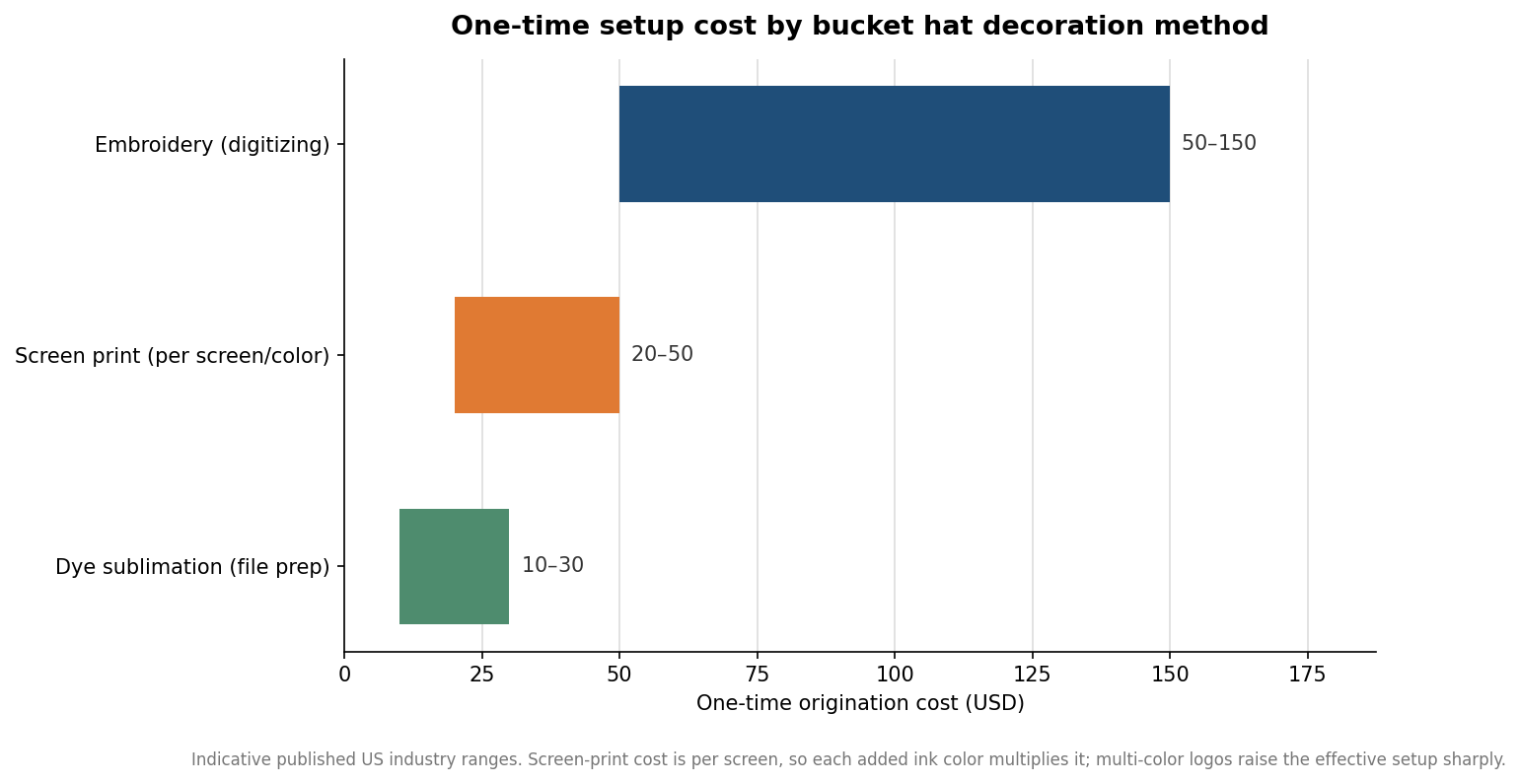
    Two questions settle most decisions: how many hats, and how complex is the art. For complexity, embroidery handles simple logos and text, sublimation handles anything full-color or all-over, patches handle detailed badge-style marks, and screen printing handles flat multi-color graphics on compatible blanks. For quantity, the economics diverge sharply, because setup costs get spread across the run.

    Embroidery carries the highest one-time setup but a flat, predictable per-unit cost, which makes it efficient across a wide range of order sizes once the digitizing is done. Sublimation keeps setup light and per-unit cost steady. Screen printing is the opposite shape: setup is spread over only a handful of pieces at tiny quantities, then it becomes the most economical option once volume climbs.

    The practical read: for a small run of 12 to 25 hats with a simple logo, embroidery or sublimation almost always wins. At larger quantities with flat, multi-color art on a compatible construction, screen printing starts to pull ahead. At Customized Bucket Hats the minimum is 12 hats, and the per-hat cost depends on the fabric, the decoration method and the quantity, so the quickest way to compare methods for your order is to request a quote.

    Specifying the order so it comes back right

    Whatever method you choose, send vector artwork where possible, call out exact thread or ink colors by reference, and state the finished decoration size in inches or centimeters rather than trusting a mockup to scale. Confirm placement in writing, front panel versus side versus brim, and ask for a physical or digital proof before the full run. Build the calendar around production plus shipping: standard production at Customized Bucket Hats is about 2 weeks after you approve the mockup, with shipping on top, so a firm in-hand date should leave room for both. The exact timing depends on your blank, decoration method and quantity.

  • Choosing the Right Fabric for a Custom Bucket Hat: A Materials Deep-Dive

    Choosing the Right Fabric for a Custom Bucket Hat: A Materials Deep-Dive

    Before you settle a color, a logo, or a quantity, a custom bucket hat comes down to one earlier decision: what it is made of. Fabric sets almost everything you notice when the hat arrives, from how it breathes on a hot day to whether it sheds a drizzle, how much the brim holds its shape, and, just as important, which decoration method will actually look sharp on it. Pick the fabric to match the job first, and the rest of the order gets easier. This is a working guide to the materials you will actually be choosing between.

    Cotton and cotton twill: the sensible default

    Cotton is the starting point for a reason. It breathes well, feels comfortable in warm weather, and takes dye and print, in one supplier’s phrase, like a fish to water. Cotton twill is the version most custom programs reach for because its surface is stable and textured enough to hold embroidery detail cleanly, which makes it the safe pick when a logo has to look crisp. A widely used cotton blank such as the AS Color 1117 shows the familiar pattern: a light-to-mid-weight 100% cotton body, a reinforced brim held down with topstitching, side eyelets for a little airflow, and a one-size fit offered across a broad colorway range from army and black to bone, butter, and ecru. That combination of a stable surface, honest breathability, and wide color choice is why plain cotton and cotton twill cover the majority of everyday merch, giveaways, and streetwear basics.

    Nylon and synthetics for the outdoors

    When the hat will be worn fishing, hiking, or traveling rather than standing around at an event, synthetics earn their place. Nylon is lightweight, quick-drying, and water-resistant, packs flat for travel, and holds color without fading in the sun, which is exactly what an outdoor utility hat needs. Polyester adds durability and strong color retention along similar lines. The tradeoff is on decoration: a thin nylon shell can make heavy embroidery feel dense and stiff, so these fabrics usually look better with woven patches and labels than with a big stitched design. If your use case is sun, water, and packability, a synthetic shell is the right body, and you simply plan the branding around a patch rather than a dense embroidery.

    Canvas, corduroy, and terry: structure, season, and feel

    The specialty fabrics are where a hat gets a point of view. Canvas is robust and holds a firmer, more structured brim, which suits a rugged or workwear look and stands up to hard use. Corduroy, often an 8-wale cotton cord, reads vintage and skate-inspired and photographs beautifully in fall and winter drops; because its ribbed surface fights fine detail, it looks best with a minimalist logo, a woven label, or a patch rather than intricate stitching. Terry cloth, the towel-like material, is soft and playful and made for beach, poolside, and resort collections, though its whole nature is to soak up water rather than repel it, so it belongs nowhere near a rainy-day brief. Matching one of these to the season and the mood of the collection is what separates a considered hat from a generic one.

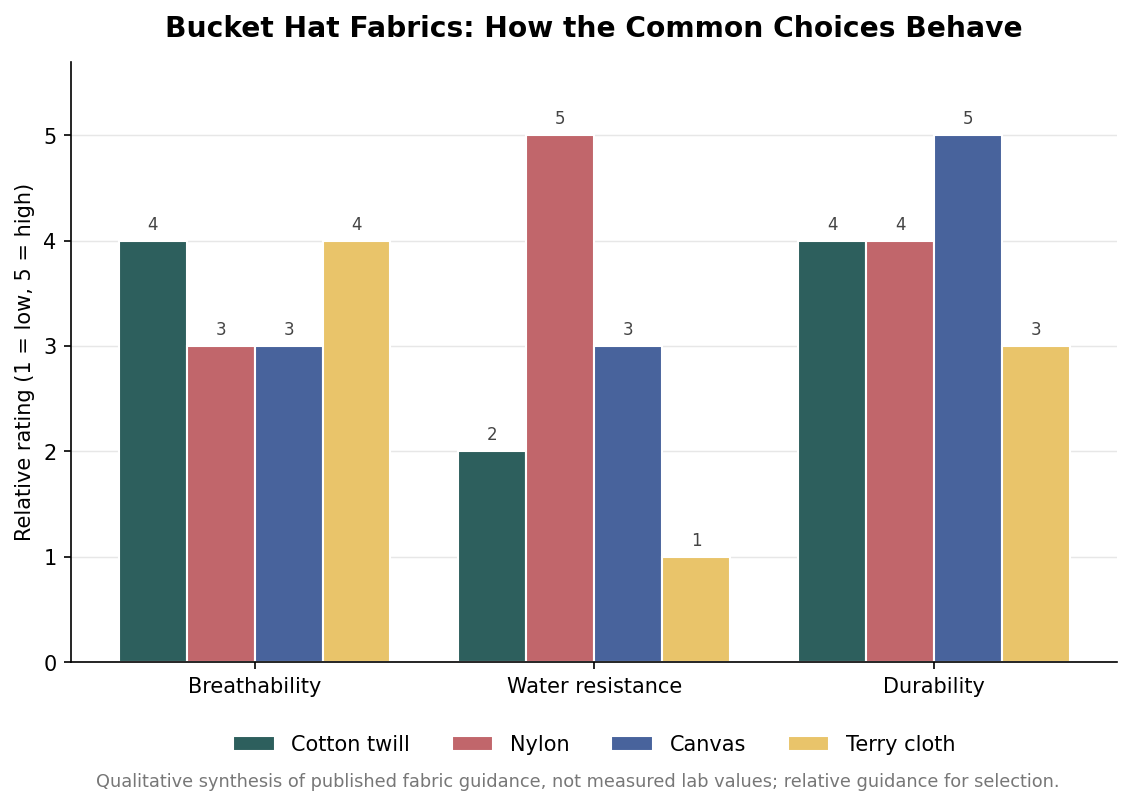
    Grouped bar chart rating cotton twill, nylon, canvas, and terry cloth bucket hat fabrics on breathability, water resistance, and durability
    Each fabric trades off differently: nylon leads on water resistance, canvas on durability, cotton and terry on breathability.

    Match the decoration to the fabric, not the other way around

    A recurring mistake is choosing the decoration first and forcing it onto the wrong fabric. The reliable pairings are straightforward. Embroidery looks best on stable, textured surfaces like cotton twill and canvas, where the stitches sit cleanly and hold their shape. Woven patches and labels are the better call on nylon and corduroy, where dense stitching would pucker or disappear into the texture. Prints, including all-over patterns, sit best on smooth cotton and polyester that accept ink evenly, which is why a camo or graphic bucket is almost always a printed cotton or poly rather than a corduroy. Decide the fabric for the use case, then choose the decoration that the fabric wears well, and the finished hat looks intentional instead of fought-with.

    What the fabric does to your budget

    Fabric is also the biggest single lever on per-hat cost before you add decoration and quantity. Plain cotton twill is the value pick, and every step toward a specialty fabric such as nylon, terry, canvas or corduroy, or toward a heavier weight, tends to nudge the unit cost up. The final per-hat cost also moves with order size, finish, and how much stitching or printing you add, so the most accurate way to budget is to request a quote for your exact spec. If a budget is tight, the smart move is to spend on getting the fabric right for the use case and keep the decoration clean, rather than the reverse.

    Putting the order together

    The clean sequence is fabric, then decoration, then color and quantity. Start from where and how the hat will be worn: cotton or cotton twill for everyday merch and events, nylon or polyester for sun and water, canvas for structure and hard wear, corduroy for a vintage seasonal drop, terry for the beach. Confirm the decoration your chosen fabric wears well, keeping embroidery on the stable surfaces and patches on the textured or technical ones. Only then lock the colorway and count. Do it in that order and the fabric stops being an afterthought and becomes the decision that makes everything downstream, the fit, the look, and the branding, fall into place.

  • What UPF Really Means for a Custom Bucket Hat, and How to Order One That Protects

    What UPF Really Means for a Custom Bucket Hat, and How to Order One That Protects

    Order bucket hats for a summer camp, an outdoor festival crew, or a school field program and sun protection stops being a marketing word and becomes a real specification. Parents ask about it, camp directors require it, and in some settings a hat that does not actually block UV is a liability. The trouble is that the label language, UPF this and UV that, is genuinely confusing, and a lot of hats marketed as sun protective carry no tested rating at all. This is what the numbers mean, what stands behind them, and how to order a bucket hat that does the job rather than just looking like it does.

    UPF is not SPF, and the difference matters

    UPF stands for Ultraviolet Protection Factor, and it measures how much UV radiation a fabric lets reach your skin. It is often confused with SPF, the number on sunscreen, but they are not the same thing. SPF is tested on human skin and rates protection against UVB only, and it degrades as you sweat or swim. UPF is tested on the fabric itself in a laboratory, accounts for both UVA and UVB, and does not wash off during the day. A UPF number tells you, in effect, what fraction of the sun’s UV the material stops before it ever touches the wearer, which is exactly what you want to know about the brim and crown sitting over someone’s face and neck for hours.

    Reading the number: what each rating actually blocks

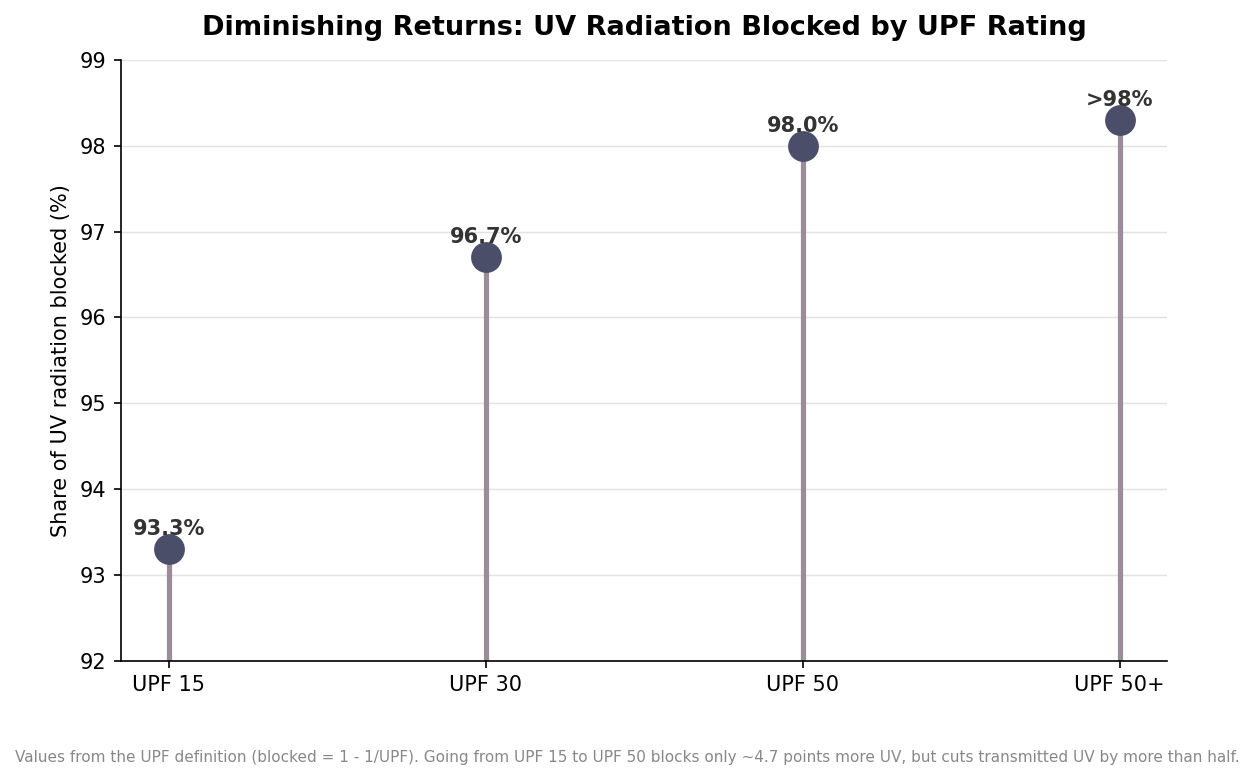
    The UPF scale is built from a simple definition. A rating means the fabric transmits one part of UV out of that number, so UPF 50 lets through one-fiftieth of the UV, or two percent, and blocks the other 98. Work through the common ratings and a pattern appears: UPF 15 blocks about 93.3 percent, UPF 30 about 96.7 percent, and UPF 50 about 98 percent, with UPF 50+ meaning more than 98 percent. Those percentages look close together, and that is where buyers get misled.

    Dot plot showing share of UV radiation blocked at UPF 15, 30, 50 and 50+, illustrating diminishing returns in the blocked percentage
    The blocked percentages look close, but UPF 50 lets through less than a third of the UV that UPF 15 does.

    The honest way to read that chart is through what gets through, not what gets blocked. UPF 15 transmits 6.7 percent of UV; UPF 50 transmits 2 percent. So moving from UPF 15 to UPF 50 only raises the blocked figure by about five points, but it cuts the UV actually reaching the skin by more than two-thirds. For a child at camp under the sun all afternoon, that is a meaningful difference even though the headline percentages barely seem to move. When a rating is required, UPF 50+ is the standard worth specifying rather than settling for a merely adequate number.

    The standards behind the label

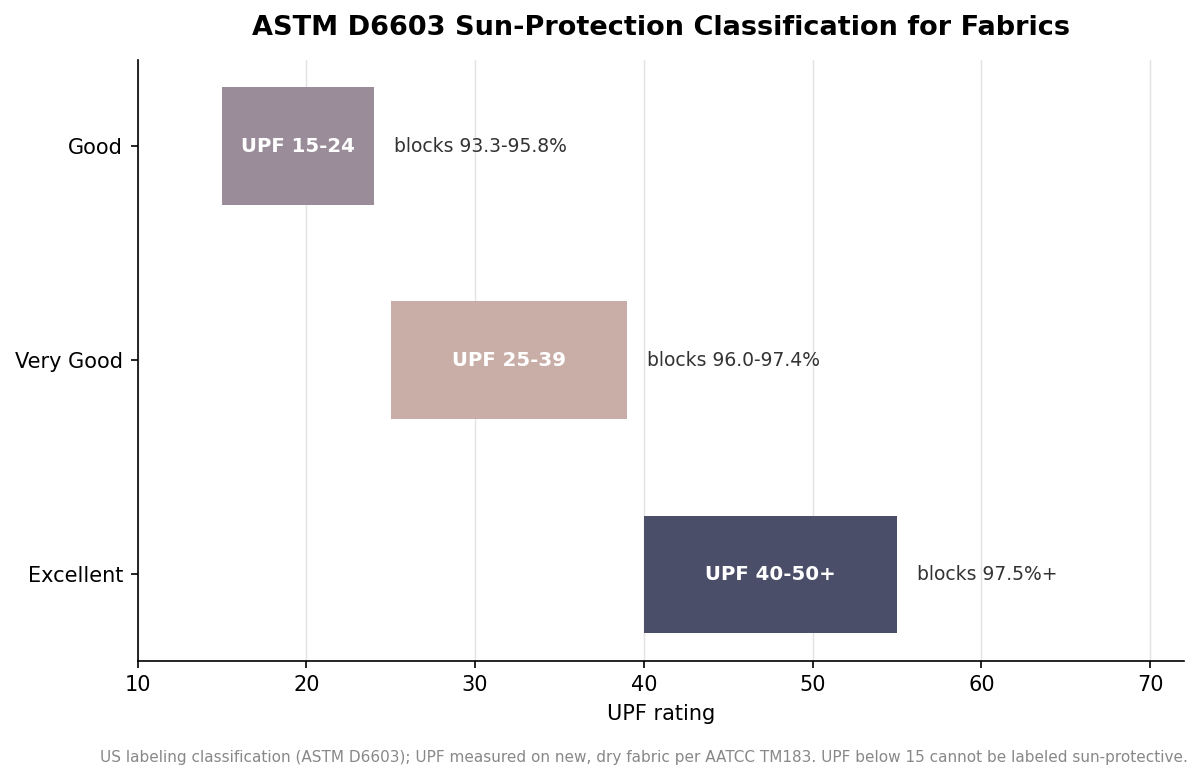
    A UPF claim only means something if it was tested to a recognized method, and there are three names worth knowing. In the United States, the test method is AATCC TM183, which measures UV transmittance on new, unstretched, dry fabric. The results are then classified and labeled under ASTM D6603, which sets the rules for what can legally be called sun protective and sorts fabrics into three grades. Australia and New Zealand, which take sun safety especially seriously, use their own calculation standard, AS/NZS 4399. The classification most US buyers will see comes from ASTM D6603 and looks like this.

    Horizontal range chart of ASTM D6603 sun-protection classification showing UPF 15 to 24 Good, 25 to 39 Very Good, and 40 to 50-plus Excellent
    The ASTM D6603 grades that determine what can be labeled Good, Very Good, or Excellent sun protection.

    Two practical points follow from how the testing works. First, anything below UPF 15 cannot be labeled sun protective at all, so a hat with no rating is not automatically UPF 14, it is simply untested. Second, because the test is done on dry, new fabric, real-world protection can be lower: a hat that is soaked with sweat or pool water can drop one or more categories, and heavy wear over a season can reduce it too. If you need a guaranteed level, ask the supplier for the tested UPF rating and the standard it was tested to, in writing, rather than accepting sun protective as a loose adjective.

    How fabric choice decides the rating

    Here is the part that surprises people: color matters far less than weave. Dark, saturated dyes do absorb somewhat more UV than pale ones, but the dominant factor is how tightly the fabric is woven and what fiber it is made from. Tightly woven synthetic fibers like polyester and nylon hold their UPF well and keep it through washing, while looser natural fibers let more UV slip between the yarns. That is why a standard 100 percent cotton bucket hat, such as a light-to-mid-weight cotton blank in the mold of the widely used AS Color 1117, protects mainly through the tightness of its weave and its crown coverage, and will not carry a high tested UPF unless the specific fabric has been tested and rated. Cotton can still shade a face perfectly well; it just should not be sold as certified UV protection without the test to back it.

    When protection is the priority, the specification writes itself: choose a tightly woven or performance fabric, favor a fuller crown and a wider, downturned brim that shades the ears and neck, and lean toward deeper colors where the design allows. When the hat is mostly a branded accessory for a giveaway or a casual event, a classic cotton bucket in one of a dozen colorways is a fine, affordable choice, and you simply describe it accurately as a cotton hat rather than a UV-rated one. Where the figures here are given as ranges, treat them as the framework rather than a promise about any one hat. The goal is to match the claim to the cloth, so the bucket hat you hand out actually protects the people wearing it and your program never has to walk back a promise it could not keep.

  • Sizing Bucket Hats for Schools and Camps

    A school order is the one place where getting sizing wrong is immediately visible, because every hat is worn on the same day in front of the same parents.

    Age is a bad predictor

    Head circumference varies enormously within a year group — far more than clothing size does. Ordering by age band reliably leaves a handful of children in a hat that either slides over their eyes or perches on top.

    Measure instead. A tape around the head just above the ears, and a simple tally sheet per class, takes one morning and removes the whole problem. We send a chart mapping circumference to band.

    Expect to split across three or four bands

    Most primary year groups need three bands; a whole-school order usually needs four. That is normal and it does not cost more — it just needs to be decided before production rather than after delivery.

    Order a small overage in the middle bands, which is where replacements come from.

    The chin cord has to release

    A cord that holds under load is a genuine hazard on climbing equipment. Specify a breakaway fastening that separates under pull, and one that can be detached entirely for children who do not want it.

    This costs the same as a fixed cord. There is no reason to accept the fixed version, and we will not supply one.

    Brims, shade and practicality

    For outdoor use, a proportionally wider brim gives meaningfully more shade on the neck and ears than an adult-proportioned one scaled down.

    Choose a fabric that washes and dries fast, and a color bright enough to spot across a playground. Both matter more than the branding.

  • How Reversible Bucket Hats Are Built

    The reversible build is the reason bucket hats work so well as merchandise, and it is the build most often done badly.

    What reversible actually requires

    Two complete hats, sewn back to back, with no raw edge and no visible construction line either way up. Done properly, neither face is the ‘inside’ — both look finished, both sit correctly, and the brim holds its shape whichever is showing.

    Done cheaply, one face is clearly the lining: the seam shows, the brim sags, and nobody wears it that way round.

    Weight-matching is the whole trick

    The two fabrics have to be close in weight. Pair a heavy canvas with a light poplin and the canvas dominates — the hat holds its shape one way and collapses the other.

    Twill with ripstop, twill with terry, and corduroy with brushed cotton are pairings that work. A supplier who does not ask about the pairing is not thinking about it.

    Two faces, two marks

    The second face doubles your decoration space, which is why sponsored merchandise gravitates to this build: the team on one side, the sponsor on the other, and the wearer chooses.

    One position per face is the sensible limit. A large mark on the bold face and a small one — often just a woven label — on the plain face is the layout that works most often.

    When not to bother

    If the hat only ever needs one look, a reversible build adds cost and weight for nothing. For a school hat, a work hat or a sun hat, single-layer is the better product.

    Reversible earns its place when the hat has two audiences: the event and everything after it.

  • The Complete Buyer’s Guide to Custom Bucket Hats

    Bucket hats look like the simplest thing in headwear and are the easiest to order wrongly, because the two specifications that matter most are almost never written down.

    Work through these in order and the sample will match the picture in your head.

    Crown depth decides the whole silhouette

    Crown depth is how far down the hat sits. Deep crowns swallow the head and read as streetwear; shallow crowns perch and read as classic or sun-hat.

    You do not need to know a number — describe the look, or send a reference photo, and any decent manufacturer will translate it and put the measurement on the spec sheet. What matters is that it is recorded, so the reorder in two years matches.

    Brim angle and width do the rest

    A short brim angled down is the classic bucket. A wider, flatter brim moves toward a sun hat. A wide brim angled sharply down becomes a boonie.

    Between about 5 and 7cm covers most bucket hats. Wider than that and you are ordering something else, which is fine as long as everyone knows it.

    Fabric, chosen for the job

    Mid-weight cotton twill is the default because it holds a brim without wire and survives washing. Ripstop nylon is the packable option: folds into a pocket, sheds a shower, dries in minutes, at the cost of a synthetic hand.

    Terry, corduroy and denim are the ones where the fabric is the design. They need almost no branding to look considered, and they are what people actually keep.

    Decoration follows the fabric, not the artwork

    Embroidery is the most durable and belongs on twill and denim. On terry it sinks into the pile; on ripstop, dense stitching perforates a lightweight face.

    Woven labels suit everything and are the modern default for minimal branding. Patches carry more detail than stitching at the same size. Print handles large graphics that nothing else can.

    One more constraint: nothing large works across a brim. The curve distorts it and the panel seam interrupts it. Keep the brim to a small wordmark and put the graphic on the crown.

    What to send when you ask for a quote

    Fabric, the look you want (or a reference photo), decoration method if you have a preference, size split and quantity. That is enough for a real quote and a mockup the same day.

    If it is a children’s order, send head circumferences rather than ages — age is a very poor predictor of head size.